Editor’s Note: Ken wrote this story and two sidebars for Today’s Christian Living, a bi-monthly magazine based in eastern Wisconsin. Although it was scheduled to appear in the September 2026 issue, the magazine ceased publication after July.
A Short-Term Campground Lives On
By Ken Walker
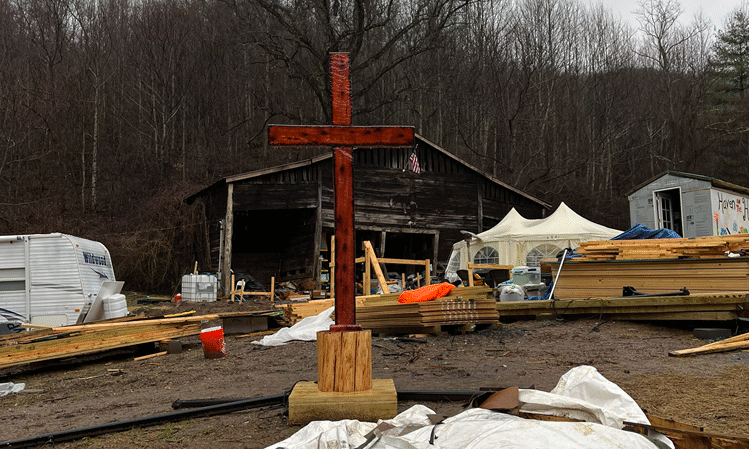
Haven on the Hill (HOH) near Waynesville, North Carolina, closed in October of 2025 after 13 months, sending the last of Hurricane Helene’s homeless victims to other parts of the state and beyond.
However, landowner James Lunsford still has proof of the temporary campground’s existence:
* A personalized HOH license plate, one of about 30 produced by a shop class at the Tennessee College of Applied Technology in McMinnville, Tennessee.
* A country ballad recorded by Nashville singer Adam Pope, which is available on YouTube.
* A ministry 80 miles east of Waynesville that today feeds the homeless and disadvantaged through its mobile pantry—a gift from the same volunteers who visited HOH in early 2025 with propane, food, clothing, and other supplies.
“We couldn’t have done what we did without people like her and Randy,” Lunsford says of Neva and Randy England. A few months after Helene blew through, the couple from McMinnville felt God leading them to help North Carolinians left homeless by the storm.
A Warren County commissioner in middle Tennessee (75 miles southeast of Nashville), Randy first tried to help hurricane victims in the Tennessee mountains. After red tape deterred him, he saw a video on the “Appalachian Man” YouTube channel. It showed a Christmas gift distribution to flood victims at a now-shuttered amusement park near Waynesville, a town of 10,000 about 30 miles west of Asheville.
England emailed the channel’s founder, John Ward, and asked if Ward knew how he and Neva could help. To his surprise, Ward replied, telling him about Lunsford’s makeshift campground.
At its peak, HOH provided refuge to approximately 50 campers and more than 100 people. Lunsford said he opened six of his 140 acres after the storm “because the counties weren’t helping, the state wasn’t helping, FEMA wasn’t helping, and winter was coming.”
Colder weather created a serious need for propane, since most occupants lacked a ready heat source. The tricky situation required inverters, which connected to generators producing electricity and allowed the propane heaters to work.Haven on the Hill (HOH) near Waynesville, North Carolina, closed in October of 2025 after 13 months, sending the last of Hurricane Helene’s homeless victims to other parts of the state and beyond.
Grassroots Assistance
Before he and Neva rounded up tanks and other supplies, Randy chatted with his pastor, Anthony Wanamaker of Pearls of Christ Church, located just south of McMinnville.
“When Randy talked to us about it and said he had a heart for it because he had camped over there, he wanted to know if we could get it done,” says Wanamaker, the nondenominational church’s only pastor in its 42-year history. “I said, ‘I don’t think it will be a problem. It never has been.’”
As the pastor describes it, help “started coming out of the woodwork.” When England requested empty propane tanks on Facebook, many folks offered two or three. A propane company employee gave his entire Christmas bonus: 800 gallons of the fuel. A Dollar General store set up a collection box that quickly got filled.
Churches of various denominations wanted to help, including sending members on some of England’s three trips to Haven on the Hill.
On one visit, the team took 85 propane tanks and food, along with three portable sewage tanks to haul away the gunk that residents had nowhere to discharge.
Lunsford told England they didn’t have anywhere to put donated food, so the farmer was planning to erect a small building for food service and furnish it with a stove and refrigerator.
That inspired Randy, who wanted to get a box trailer and install shelves to hold canned goods to supplement Lunsford’s effort. Neva checked Facebook Marketplace and found a trailer; the owner also donated lumber to the cause. A construction class at the technical college built shelving, while an electrical class installed lighting.
“We put a sign on it saying where the food was going and where it was from,” said England, who left the trailer behind for HOH’s benefit. “I felt we needed to help with the kitchen they were going to build.”
Donations enabled him to buy a tankless water heater, two stainless steel prep tables, a propane gas stove, pots and pans, and utensils.
Expanding the Crew
On his second visit in mid-February of 2025, England welcomed a newcomer to the relief crew: fellow Exchange Club member and Raleigh-area resident Randy Hall. The two friends had met years earlier at an annual meeting of the 115-year-old community service organization.
Just days after learning of the devastation, Hall sensed “strange feelings,” the kind of Holy Spirit stirrings that in the past had prompted him to go on missions or disaster relief trips. They went so many times wife Kim had dubbed them “Hall Adventures.”
“I need to go,” Hall said to Kim one Sunday just before a service at First Baptist Church of Garner.
“What do you mean?” she asked.
“I’ve got to go help those people in the mountains,” he replied. “The Lord is telling me I need to help. Some way, somehow.”
“You’re not young anymore,” said Kim, whose husband was about to turn 64.
A few days later, after learning about England’s plans to take more supplies to Waynesville, he shot his wife a “I told you so” look. Then he got inspired to join the trip, asking Exchangers to donate money to help the Halls buy canned goods to take along.
By the time the grapevine had circulated word among the Raleigh area’s six clubs, the Halls had nearly $1,800 for the mission.
The day the Halls met the Englands and their crew in Waynesville, the Tennessee contingent brought along a hundred 20-pound propane tanks, two gas ranges, canned food, and numerous articles of clothing and toys.
At HOH, the crew set up a pair of 10-by-10-feet canopy tents and opened a covered box trailer to grill pancakes and sausage. Because of the drizzle that day, only about 10 people came down the hillside for breakfast. So the volunteers loaded food into portable containers and delivered it to trailers strewn around the land.
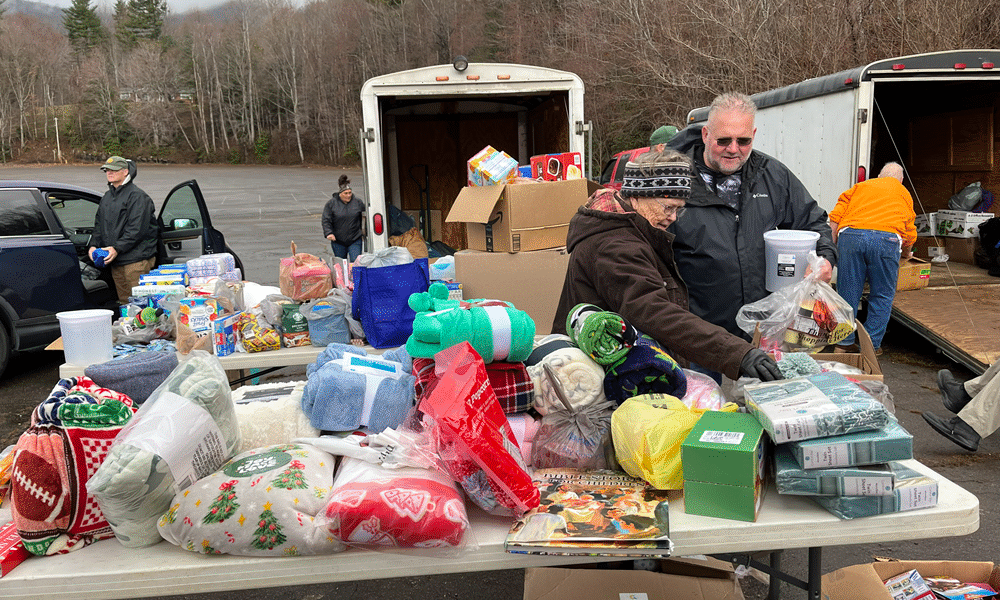
After breakfast, the group met Ward at the former amusement park (Ghost Town in the Sky), along with other volunteers. One man cooked up 30-gallon pots of Brunswick stew. England’s group set up a display of donated sporting equipment, clothing, snacks, and other supplies, such as hygiene products.
Hall called it remarkable to watch people with next to nothing picking up only one or two items, as if they were shopping at a discount store.
“They didn’t want to take too much when other people needed it,” Hall said. “We told ‘em, ‘We have a thousand pudding cups. Take ‘em.’ We probably saw 50 to 60 different families, including grandmothers coming up with grandkids.”
One More Donation
England returned home from one trip feeling humbled after talking with a woman in her mid-60s. She had camped in a tent under an overpass before someone offered her a trailer.
“She said, ‘I’ve got a quilt, a coffee pot to make coffee, clothes on my back, and a warm place to stay; that’s all I need,’” England said. “She was so thankful to have a roof over her head. I realized I have a lot of things that I don’t really need.”
Back home, he told Neva that he sensed a divine urge to buy another trailer for Sisters in
Christ, a ministry 80 miles east of Waynesville. Founders DeAnna and Ronnie Sisk had shown up at Ghost Town with food and clothing to give to campers.
At that point, England had $2,100 in donations left. He started looking for a trailer and found one for $3,000. After making up the difference, he took it to the trade school. Randy told the instructor of the construction class that he wanted to install a refrigerator, a large deep-freezer, shelving, lights, and a generator—and he didn’t have any money.
That changed the following Monday, when his primary care doctor asked England to stop by after school. When England arrived, the doctor told him, “At church yesterday, we discussed what you were doing, and we took up a love offering.”
Then he handed Randy a check for $5,500.
“When I called my wife, she said, ‘God wants you to finish what you started,’ England said. “We went to Lowe’s and bought a refrigerator, a freezer, had new tires and bearings put on the trailer, toilet paper, food, and everything we could, and packed that trailer full.”
Even though England had spearheaded raising $10,000, plus in-kind donations of food, clothing, toys, and other items, as the project wound down, his conscience started gnawing on him. Feeling bad about having to quit, he told Pastor Wanamaker, “It’s so far away I can’t keep up with it.”
“You planted the seed because it’s what God wanted you to do,” the pastor replied. “He’s allowed someone else to do the harvest. Don’t worry about it.”
“It had an impact, no question about it,” Wanamaker said recently. “If there was just one soul who turned to Christ, what’s a soul worth? Any time the Lord lays something on your heart, you need to respond, no matter what it is. You’re being obedient, and you don’t want to lose your reward by not being obedient.”
Enjoying the Story?
Ken Walker is a freelance writer and book editor. He has written thousands of magazine, newspaper, and website articles over the years, and co-authored, edited, or contributed to more than 100 books.
If you would like to say thank you and help defray the expenses he incurred on these stories,
you can send contributions via PayPal.
Sidebar #1
Sisters in Christ:
Helping Hand
On his mid-February 2025 trip to Waynesville, Randy England met Ronnie and DeAnna Sisk. The founders of Sisters in Christ ministry had also brought a load of clothing and other supplies to help hurricane victims.
“We heard you built folks here a food trailer,” said DeAnna. “Could you build us one too?”
That set in motion the fundraising and other steps that enabled England and another couple to return in early March with a box trailer. Labeled “Sisters in Christ Hope Village,” it included the names of the two Exchange Clubs that helped fund the project.
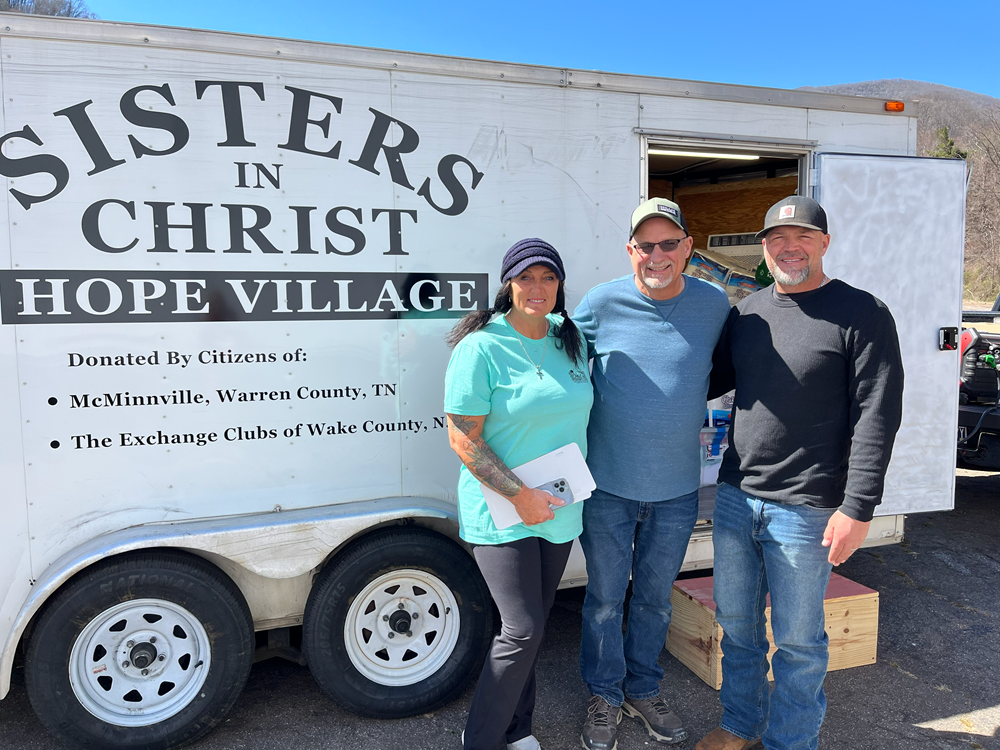
“When they pulled up in their truck, DeAnna got out and started bawling,” said England, who teaches a machine tool technology class at the vocational college. “She and Ronnie explained they could get produce, meat, and supplies from grocery stores, but had nowhere to put it. She said, ‘You don’t understand how much this is going to help us.’”
Sisters in Christ’s name comes from the fateful day in 2000 when then-pre-Christian DeAnna went for a pregnancy check at eight months. She learned she had contracted HIV (the precursor to AIDS) from a man who never told her he had the virus.
“I thought I was doomed,” said DeAnna. “I was dying and had a baby in me, and the doctor told me I only had five years to live. The only other people in the room with me that day were my two sisters and Christ.
“I will share with the world what the Lord has done for me,” added DeAnna, who felt called to launch Sisters in Christ in 2011 to help the homeless and down-and-out in her area.
Sisters in Christ Village provides help to people forced to live in tents, while Sara’s House of Refuge is a mobile home providing short-term housing.
The ministry also distributes canned goods, toiletry items, clothing, hats, tents, and emergency medicine.
“The mobile unit has blessed us in all kinds of areas,” DeAnna said. “Lately I have been on a mission for the Lord, helping people whose houses burned down. We use the trailer to haul materials and stuff. The Lord’s opened another season in our life.”
Sidebar #2
Exchange Clubs Boost American Communities
Randy England met Randy Hall about 28 years ago at an annual meeting of Exchange Clubs. Founded in 1911 in Detroit, the organization later moved its headquarters to Toledo, Ohio. It now encompasses more than 500 clubs and some 13,500 members.
The organization’s founders created Exchange as a mechanism to help business and local leaders give back to their communities. The clubs around the Raleigh, North Carolina area and in McMinnville, Tennessee collectively donated nearly $2,500 for the duo’s 2025 disaster relief work in western North Carolina.
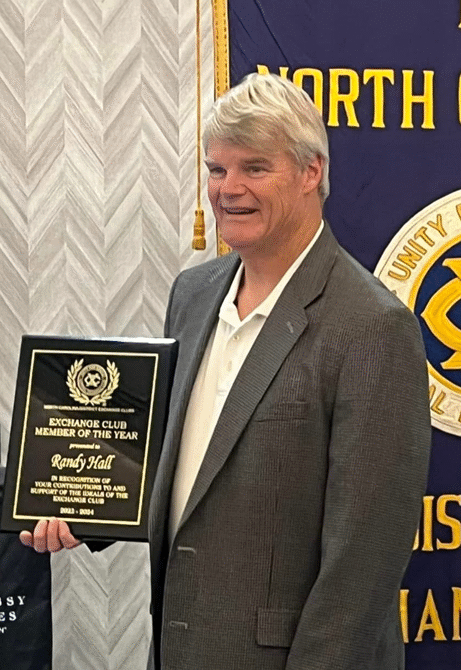
Both Randys have been named “Exchange Member of the Year” by their respective clubs and are active participants in several initiatives, including Exchange’s national project to prevent child abuse.
Hall is a trustee of the North Carolina District Exchange Club Foundation for the Prevention of Child Abuse.
Every year at the national meeting, England—an auctioneer on weekends—conducts an auction to help raise money for the cause. England has also helped raise funds for other affiliates around Tennessee.
Sue Liles, New Hope-Wilders Exchange Club’s secretary (and North Carolina district secretary), said over the years Hall has taken the lead with several projects for Wake County.
“Randy had the vision for our first club pinwheel garden for child abuse prevention in Knightdale (a suburb of Raleigh),” Liles said. “He devoted many personal hours and dedication to the Wake County events, in addition to serving on the Foundation for the Prevention of Child Abuse. We wish we could clone him for his energy and dedication.”
While grateful to have played a role in the project started by his friend, Hall is most pleased that he recognized the Holy Spirit leading him to help people in the western part of his home state.
“It just strengthens my faith,” Hall reflected. “It makes me feel good that I know I can still hear the Lord. When He’s motivating me, I don’t ignore those inputs anymore. Many times I pray, ‘Lord, cleanse this vessel so I can be of service.’”
All photos courtesy of Neva England.